Playing the long game…

This past week, I had three instances when I was talking to someone about how I am working on my first book.

As I wrote earlier, I have been inspired by my dad’s will to finish and publish my grandfather’s magnum opus. With this inspiration, I took it upon myself to translate the book, originally written in Hindi with Sanskrit words, into English.

I chose English because that’s how I think and write. But more importantly because I feel that will help me expose the book to a far wider audience.

As I was talking about it this week, it felt good that I am able to contribute to this legacy that our family holds.

Then, as I reflected back on those conversations, I realised that it isn’t just because I am contributing but also because I am picking up a challenge!

The challenge of translating my grandfather’s poetic flourishes into an equitable prose form. Translating a story steeped into mythology into something which is perhaps more relatable to the current generation.

While these thoughts were overwhelming, I also echoed the goals I have set for myself during these conversations.

This year is dedicated to understanding the original version. The next year is meant to start translating and writing down portions. And the one after is when I hope it will all come together.

By breaking down my ambitious take into smaller goals, I feel I am helping myself. To be able to measure progress in one’s pursuit is helpful and I should be able to do that with these goals.

I may slip a bit sometimes. For example, I haven’t been able to spend any time on the book reading with my dad for the past three months. But I know that having gone through sixty percent of it, I have time to do it before the end of the year.

Maybe I will slide some more and miss some goals. But I will continue to strive to keep myself in pursuit without too much deviation.

For playing the long game requires planning and patience…

It also requires to be appreciative of the phases when things don’t go as per plan. And then recover and start again.

Something worthwhile for us to think about in general in our life!
Legacy…

It is something we leave behind and hand over to the next generation.

Something that inspires a lot of people and helps them identify a meaning in all they have done through the years.

Or something that in hindsight helps us judge what we did in that particular phase of our life or work.

Well, I have always viewed the term with some suspicion. Not because I think it is over-rated but because I think it carries a negative stress in the present.

There are a few people who leave impressive legacies behind. But not because they started with that intention. They just wanted to do their best in the moment. And whatever they leave behind happens as a natural result of that effort.

On the other side, there are those who don’t bother at all about these matters and live their life without worrying about what they are leaving behind. They do their work or live their life and pass into oblivion, which isn’t a bad option in the larger scheme of things.

And then there are those who always get bothered by whether what they are doing will be enough to leave behind that impression. Now, that’s precisely the kind of negative stress I am referring to. Trying to prove a point and do something with the future in mind, without focusing on ensuring the best possible in the present.

A lot of us these days, either due to the hype around the term ‘legacy’ or because of the added pressure we put on ourselves to excel in whatever we do, land up in the third category. For some of us in fact, sometimes it gets complicated because once we start looking out into the future with one eye, the view isn’t complete in the present. And due to that stress we sometimes end up trying too hard and not being our natural self, or worse, doing things the wrong way to reach where we want to be through a shortcut.

Not something that we would recommend to any of our friends, leave along to ourselves!

As I served my last day in a company I have been with for almost 5 years and had a lengthy conversation with a senior about some of these aspects, these thoughts came into my mind…

When I dug deeper, I realised that if we look at this issue from another perspective, it is actually not what we have done and the accolades that we have bought to the table that matter. What matters is the foundation we built or built upon, and the strength of the pillars we erected during that phase of our life or work. In the present.

Are they going to sustain after we are gone? Will those, who are left behind after us, be able to live with it? Is the structure going to soar higher from where we left it?

I think that is a more pertinent way of looking at any phase of our life or work and determining the impression that we leave behind. It also gives us the luxury of focusing on the present completely without worrying about or stressing about what happens to it after we leave.

While all of us are wishful about the impact we have or may have with our actions or work or life in the future, I guess living in the present and staying focused on what we are doing in the here and now are way more important.

At least, that gives us a chance of leaving behind a legacy, if at all!

Leaving a Legacy!!!

While on a long travel, I decided to pick up a book which had been long sitting on my shelf (the digital one, thanks to numerous options on the iPad which has become my constant companion, so much that sometimes my wife laments “try something else rather than the iPad today”!), Empire of the Moghuls, written by Alex Rutherford.

As I lost myself into the plot detailing the life and times of Babur, the ruler who established the dynasty, I understood how they became one of the most successful rulers of India. From my childhood, I had viewed the Moghuls as the most successful empire in India and perhaps more so because of the history books than my own research. But never really went to the extent of understanding the reason, until the book revealed the answer to me…

The book is a brilliant account of how Babur built the empire right from his early childhood when he was declared the king owing to his father’s untimely death when he was 13! The story runs through his struggle of capturing and losing Samarkand, the famed city, multiple times; being without the throne for years together, hiding and running from his enemies; constantly suffering from a fear of will he be able to do enough; and finally fulfilling his desire to capture Hindustan.

But most importantly, the one thing which runs through the entire account is his urge and incessant desire to leave a legacy. In his own words “What will I be recalled as, and what will I leave my generations to come, and how I am remembered tomorrow”! In short, about “LEAVING A LEGACY”.

This particular thought is what drives great men, I believe – What is it that they are going to do that is going to leave their mark on humanity and for generations to come together they are remembered for what they did. And I could feel it in my stomach as I read Babur’s life account of how it must have been for him to go through the trials and tribulations of building his empire. This is what I believe drives a lot of us, members of the entrepreneurial clan…

To be an entrepreneur is not easy, it’s bloody difficult. One has to go through the most trying times of their life, lead themselves and those who believe in them through some of the most darkest paths they have ever encountered, face every adversity and still maintain their wits and guts, and most importantly never lose sight of what they want to achieve. And as anybody’s guess, most give up on this treacherous path before it winds down!

But what lies ahead of this so-called path? An absolutely stunning life, which only some are able to conquer, more in their minds than in the physical way. And all that one ever wants in his life, all the satisfaction, all the glory, all the dreams become possible…

As with what Babur did, and what most people who today are successful businessmen have done, it’s a once-in-a-lifetime opportunity for you to do something great and create a compelling story out of your life. So go for the glory, just don’t sit back and keep thinking, the path is anyways going to throw surprises galore along the way!

Is it worth it? Absolutely…

20140222-141303.jpg

Different Worlds!!!

 
As a follow-up on the previous post about the Theory of Work, I was thinking about how different are the worlds of an Employee and a Businessman. On deeper evaluation, I realized the entire difference lay in how they approach life…

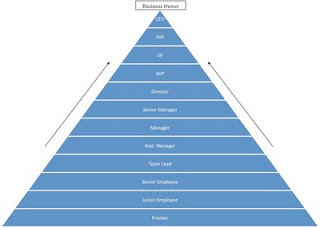
To illustrate, I can use the proverbial Pyramid and highlight the difference. For an employee, the pyramid looks like this, starting from the bottom–

When an employee starts his work, he is a fresher, right out of college. Maybe he has acquired some higher/niche skills because of which he might start at a pedestal or two higher. But the essence remains that he gets embroiled in a RAT Race where he is aiming to go higher and higher up the corporate ladder, ensuring he doesn’t become redundant. What he forgets is that even if he succeeds in touching the highest pinnacle, which is highly unlikely, he will still be in the RAT race. Moreover, in this entire process, he will lose his life – of which he has just one; and his energy – which will get sapped. Even if he is the chosen one, touching the highest pinnacle, it is the glass ceiling beyond which he cannot even think of breaking through.

If we look at this slightly deeply in correlation with the Theory of Work, what he does is spends his life working for someone else in a sort of a prison. On weekends when he gets a couple of days off he behaves like a free bird trying to do

everything that is possible within his reach to feel good about his life. But he knows he has to go back to the prison again the next week. So, he keeps grinding through his life and most probably dies thinking if he could have done better.

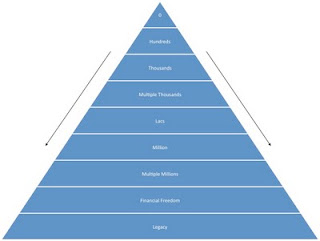
On the other hand are business owners. For them, the pyramid looks like this, starting from the top –

When a business owner starts work, he gets paid ZERO. He puts in his hard work, his blood and sweat, his life’s worth in building up his idea, his business, with passion and hunger for success. It is not necessary that he succeeds in the beginning – he might fail and falter multiple times. But if he remains true to himself, he learns and imbibes good things, steers clear of his mistakes, and slowly starts to build up the business. He puts together a team that shares his vision and is tuned to the organization’s mission and then the multiplier effect slowly sets in and the leverage shows up. He then keeps building the business and gets paid more and more while his work keeps on reducing and reducing.

This happens till the point he reaches Financial Freedom, a stage where he becomes redundant. At this stage, he does not need to work to ensure that money flows into his bank account. He has built the business and now his team carries it forward whilst he relaxes and enjoys his life. For all the hard work that he puts in for those 5-10 years, he now gets back double. And what he leaves behind when he dies is a LEGACY – for generation(s) to come…

Where do you want to be – in the RAT race or building a legacy? Do leave your comments…

The Theory of Work!

Across the human world, there are lots of people doing varied kinds of professions/businesses etc. However, as per Robert Kiyosaki, a world-renowned author who is a self-made millionaire and writes on Financial Education, anyone earning money through legal/ethical means falls under one of these categories –

Employee: Someone who works for a businessman/company and dedicates 8-10 hours of work from his daily life. This person basically trades his time seeking security and at the end of the month draws a pay-cheque, which in most cases is no where equivalent to the kind of effort put in.

Specialist / Small Businessman: Believes in doing everything with perfection, believes he is the best – Doctors, Lawyers, Professors, Consultants, Small-time shop owners etc. These people also at the end of the day trade their time and draw an income equivalent to their skills and effort (which is definitely more than most employees) but still seek security like employees do.

Big Businessman: As defined by Forbes, a person having an organization of more than 500 people. These people don’t believe in working for others but instead leverage others. All employees working for a business owner contribute to the profits that he makes while being paid a pittance. By leveraging manpower, these people move up the value chain and attain freedom – of time, of money and most other things.

Investor: Again, as defined by Forbes, someone who earns more than USD 200,000 of income from his investments. These people also leverage to earn money – but they leverage money itself. Their money works for them while they holiday with their family. In turn, they generate more income for themselves and are free for life.

As per world statistics, 97% of the world population falls under the E & S quadrants, trading time and yearning for the eluding security. Only 3% around the world actually understands the power of leverage and works towards attaining freedom, being in the B or I quadrants. However, if we look at the world-wide wealth distribution, 96% is controlled by people in the B & I quadrants and only 4% is left for souls in the E & S quadrants.

Given a chance, where would you want to be???

Another interesting facet of this theory I can explain drawing an analogy with the world of athletics…

Now all those 97% of people in the world do one common thing. They blindly run a Marathon of “Go to work, come back home” for all their life – 30 to 40 years! If you belong there, think if you would be able to sustain this schedule in these ever-changing times when security has become a myth and you never know what can happen in the world. But even then, a lot of people continue doing this and teach their kids exactly the same thing – Study hard, get a good job. Their kids might earn slightly more but in the end they are also running the same rat race!

On the other hand, a person in the B or I quadrant works smartly – he runs a Relay! He is alone in the beginning in most of the cases, and starts running. Then slowly he meets people who understand his vision and join him and the team takes shape. This team runs together, generating more output with lesser individual effort. In some time, the first person passes on the baton to the team who run the show with a bigger team. However, even after passing the baton and stopping his run, the person continues being paid because he has built a pipeline – an income stream that will continue paying him irrespective of what he does because he utilized the concept of leverage to build the pipeline…

Wouldn’t all of us want to have a pipeline of your own? Something that can keep paying us and our family for years and generations to come without having to worry about the work part…