You vs You

I had woken up in the middle of the night, sweating profusely. Lying down in my bed in my room within the confines of the Indian Military Academy, I had just had a bad dream.

It wasn’t as much a dream as a replay of my worst fear. I had flunked a physical test that day, in the first attempt in my second and final term at the academy. Back in those days (don’t know if this still holds), we were given three attempts to pass the physical tests. No prizes for guessing that if we didn’t, we couldn’t pass out and become an officer.

My dream was about this failure. That I had flunked the third and final test too and was going to get relegated to another term!

Well you see, I didn’t get into the academy with a lot of strength. In fact, most of us didn’t. Hence, the training was designed in such a way that we build that strength gradually. And the tests were also designed in such a way that we needed to build that strength, right from our head to our toe, to pass them.

Having cleared the first term, we already knew what was in store for us in the second term. But some of us, including myself, had taken it lightly. Until the first attempt. And then suddenly a sense of urgency was kicked into high gear.

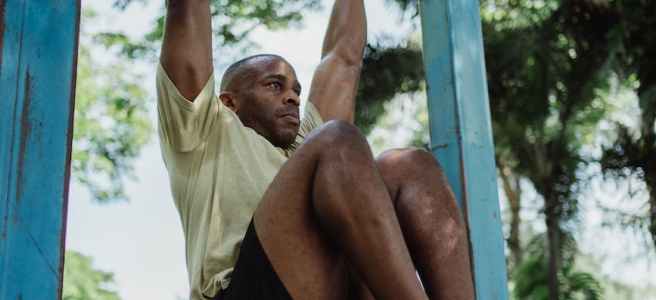
My nemesis was the toe touch. Basically an exercise to test one’s core muscles, it involved hanging on a pull-up bar and then curling your legs at the knees, bringing them to your chest, and then rolling over backwards, such that your toes touch the bar.

It was a difficult one for most of us. Only some chaps, having built enough core strength, had sailed through in the first attempt. While that was some solace, it still meant that there was tremendous work needed to get in shape for the second attempt. A month away.

I was at the lowest level in that exercise then. That meant I could bring my knees folded to my chest, but didn’t have enough core strength to then roll over. Not even an inch.

So, a few of us who were at the same level, formed a squad and got to training. That meant constantly working on our core strength, doing a truck-load of sit-ups and planks, eating in a calibrated fashion, and challenging ourselves on the pull-up bar everyday.

Cutting to the chase, in that one month, we all put ourselves on a regime that extracted a lot from us. Going all in, we didn’t leave even a single bit to chance, steeling our minds to the task. Most of us sailed through in the second attempt. Those who still needed more work, got through in the third one.

But that also taught me one important thing in life.

Most times, it is just you vs. you!!!

We come across multiple challenges in our life. Some of our own choosing, some that just crop up and then some which are thrust upon us. Whatever it may be, most times we must singularly work to overcome it. We may get help from others but unless we have resolved in our mind to ace the challenge, we won’t.

When a new one crops up, we may look at it with skepticism. Will we be able to do it? Will this mean we going beyond our known limits? As long as it is healthy skepticism, it is good. It keeps us in check and grounds us. What we need to be watchful about is that it doesn’t turn into a constant worry and acts as a roadblock.

I believe that’s the key to taking things head on. And succeeding. Knowing what we are up against, and what we need to do to make it count, is half the battle won. The other half is just executing on the plan.

After all, what is life without a new challenge and a plan to overcome it…

What’s with the Age?

We have progressively started living longer lives. But what does it mean to age?

The past week, there were two instances which forced me to think in this direction.

The first one was when my daughter asked a great question, something kids are privileged with. It went something like “why do you need to work on a laptop”?

The second one emerged from a casual conversation with a colleague about how the world has changed for us over the last 25 odd years. And that means most things we do today are done in a different way than when we were born.

As I thought about it, I started looking at my life and how it’s progressed and then to make things more interesting, looked at it from my parents lives.

Imagine someone born in the 50’s in India. Didn’t have radio as a widely used medium, mostly consuming information through newspapers. As she grows up, most interaction is limited to immediate family or neighbourhood.

Then, once she reaches college, she starts to listen to radio and watching more cinema in the theatres. She gets an occasional new thing in her life like a watch or maybe takes a trip to different places to learn.

Years later, well in her 20’s she discovers television, refrigerators, and some bit of computers if she is lucky. But the usage is limited to occasional.

It’s only in her late 30’s that she learns about the Internet. She gets to know how to operate a microwave oven and a washing machine. And a car really becomes a regular vehicle of choice.

With the turn of the century, in her 40’s, life changes as the mobile phone becomes ubiquitous. Internet becomes comprehensible and working on computers becomes the main thing for most office goers. International vacations become widely affordable.

But it’s not until probably in her 50’s that this lady discovers a smartphone. Facebook and video calls. YouTube and WhatsApp. Connected cars and live streaming enter the lexicon in her 60’s.

This lady who is inching towards her 70’s now, has come a long way. And she has had to adapt every step of the way to new things that she couldn’t even imagine as a child. Learning and unlearning, adjusting and accommodating.

For us born in the 80’s or 90’s, most things today seem like a natural progression. But if we think through this lady’s perspective, we realise most of these are way too much to handle.

Yet, our parents handle them on a daily basis. Enjoying the process of getting to know new stuff. Sometimes befuddled, sometimes bemused, but mostly a sport.

And that’s the essence of aging beautifully in today’s material world. Adapting, learning, letting go of things but still holding on to the older self, exploring new things with a keen mindset, and being ready for new experiences.

Perhaps with a new set of questions that we need to ask our kids and grandkids as we make sense of the changes about to come…

Moving Places

We started off as nomads. Adventurous people, living for the moment.

Then, somewhere along the way, we settled down. And became comfortable. With the knowns.

Somewhere, within the economic rhythm of different times, we got the notion that if we settle down and keep working our way through, we will eventually get where we want to.

But what we missed noting is that as our comfort converted into inertia, we got too naive. About other places. About other people. About other cultures. And most importantly about how that newness enriches us.

True, the world has become more globalised. We are travelling far more. People are moving places more than they ever did before.

But are we using that as an opportunity to create that wealth of experience for ourselves? Are we among those people who are ready to have some adventure in life, unsettle a little, experience the wild (not literally always)!

This week, as I started to figure out how to wind up things before a planned relocation, I came across this realization.

Most of us, including myself, in seeking steadiness, have become staid in our lives. We eschew the unknowns, confine to the tried and tested, and smirk at discomfort of any kind.

Even if we face some displacement, there are lot of anxieties that crop up within us. We tend to overanalyse impending changes a lot and weigh too much on pros and cons, to the detriment of our own sanity at times.

It doesn’t need to be so though.

If we just look at life as that adventure that’s waiting to give us a ride, and take ourselves slightly lightly, we will realise that any change is for the good. It always helps uncover things that we didn’t know about ourselves.

And while transitioning through that period of change is cumbersome and not necessary, the process itself yields benefits beyond what we can perceive at the beginning.

Easier said than done, however. Speaking about it from self experience…

Perhaps, the only way out is to believe and roll with it!

Livin’ on the Edge!

This post is in fond remembrance of the roller coaster. Not that amusement parks have gone anywhere but it’s been ages since I visited one, so apt for me to pay my respects.

And not just because I want to go to such a place. Of course, who wouldn’t want to forget all worries and be childlike for those brief moments when you experience bliss (unless you’re freaking out about the possibility of a loose screw somewhere!).

It’s also because thanks to a few planned and unplanned trips, this past month made me remember the good old roller coaster again!

You see, when you travel on roads in India, that’s the feeling you live with all the time. Who said we don’t know how to have a good time. We do it every day of our lives.

As has often been written and mentioned, driving on Indian roads is an art. It’s one that all of us learn pretty much as we grow up and only hone as we get older.

It’s like an enthralling, never ending ride. You keep swerving and swooshing all around. Sometimes out of choice. Sometimes out of compulsion to avoid hitting someone. And sometimes just so that you remain alert while driving!

So, as it happened during my trips, I was mindlessly observing how most people drive. Sitting on the other side of the driver gave me all the time in the world to indulge in this guilty pleasure. And then I observed some more as I drove around town recently.

Well, most of us Indians drive crazily. Period. We don’t know what is a straight line, what is a lane, what are signals for, what is meant by road signs, why there needs to be space between two vehicles, why we need to drive on one side of the road if it doesn’t have a divider in between to separate up and down traffic. The list is endless.

But this is still ok. Our best behaviour is around a signal. When we all are supposed to come to standstill. It’s almost as revealing as attempting a psychometric test. Let me try to explain.

As soon as we near a signal, if it’s a green light, we want to cross over come what may. Even if that means running over someone. Or jumping the signal just as it’s changing colours. We pride ourselves on the ability to beat the timing. After all it’s all about living on the edge…

Even better is when the signal turns red. The vehicles come to a screeching halt. And then everyone starts swerving here and there. As if standing at one place is a crime. The bikes navigate every possible angle to squeeze into any open spaces. It’s like water taking the shape of the maze and filling up all the vacant areas. We don’t leave even an inch. Because of course why waste space! And don’t you forget, the marginal gain is much higher than the few seconds we would lose being two steps behind.

As the signal turns green and we start again, we start to play hide and seek. Swerving and changing lanes at will without any indications, driving as close to each other as possible with absolutely no margin for errors (we are born Schumachers!), honking mindlessly, swearing unconsciously. Mimicking a hungry snake trying to make its way through the ground, wanting to catch its prey at any cost.

Until we reach our destination, we keep up this behaviour. Because no one likes changes, you see. And then as we park and get out, we mention to ourselves “Indian traffic is getting worse by the day”…

For us, it was a hectic but satisfying ride. After all, we beat 3 autos and 5 cars to our destination. To an uninitiated onlooker, it might have been the best example of living on the edge. And how not to drive…

Short-term View

There are people who do the right thing, no matter what. And then there are those who try to do something to take advantage of the situation or get through by any means, even if it means dishonesty.

I often try and behave in the former fashion and naturally like people who also try and do the right thing. I somehow am never able to agree with or like those who try to take undue advantage or are dishonest.

Last week, as we were on a trip, I experienced an incident of the latter type that left a bad taste in my mouth. It was a minor one involving the taxi driver of the cab we hired for our trip. As we ended the trip and had to pay the remaining charges, the driver came up with some false claims and insisted on getting paid for it. While it was a small amount and didn’t affect me much in any which way but what it did end up doing was negating any respect I had for that individual.

As we carried on with our trip, that evening when I sat down with the cool breeze of the lake shore, I reflected on his behavior and what may have caused it. You see, he had behaved immaculately till then but as soon as it was time to depart, he acted with a certain amount of dishonesty and greed. So, it was unexpected for me.

But as I thought deeper, it occurred to me that we often try and take a very short-term view of things. Whether it is something about work or in dealing with others or at home, we often get caught in this quagmire when faced with a choice. Do we think about it from a long-term perspective and are ready to forego certain advantage or benefit in lieu of the relationship or service standard. Or do we think about it from a short-term perspective and try and extract the maximum at that specific moment.

Most service industries or places around us believe in the short-term benefit policy. Why yield when we can get more? Not realizing that in the process the customer leaves with a unsatisfied experience and probably never comes back. On the other hand, those who truly put the customer first provide for a superior experience and have customers for life.

Extending this a little, even in our relationships when we prioritize short-term we gain little in the long run and actually end up fracturing them. But when we focus on the long-term and ensure priorities align accordingly, we continue holding those relationships for life.

In fact, even with any kind of work or activity we undertake. If we keep our focus on the long-term, we get deeper and more involved, benefiting ourselves and enriching our experience. On the contrary, anything attempted with a short-term focus generally is a very superficial one.

Basically, long-term pays more than short-term. We still choose short-term sometimes, neglecting this universal truth. Perhaps because of circumstances, perhaps because of helplessness, or perhaps out of habit.

Whatever it may be, better to think once before deciding on anything with a short-term focus. For while we may gain immediately, we don’t know what all we actually end up losing in the process…

Strong and Weak

Strength is always considered a virtue and weakness a thing to be avoided. But what if we have been thinking all wrong?

1

When I was undergoing training at the Indian Military Academy, we went through the toughest of routines in our initial days. It was a routine that’s usually the case for most armies but not normal for civilians.

So, naturally it took us time to adjust our bearings or even consider it as possible. A lot of us cribbed about it in those initial days. Most of us got used to it in a month or so but a few who couldn’t left.

We thought of ourselves as stronger than them and much more worthy! Naively…

2

All of us tennis fans had a tear in our eye when we watched Federer for the last time and the way it all happened.

However, someone completely clueless about tennis, who saw just a picture of Federer crying in a post match interview after losing (not his last one but some of the earlier ones), may think of him as a sore loser.

Not knowing that here stands a once in a lifetime champion, who’s crying not because he lost but because of the love and support he had received from the crowd and how he felt about it. He was just letting his emotions show.

How wrong would that assumption be about the strength that Federer, or for that matter any other champion, carries within him…

3

Travelling in the Nilgiris mountain ranges yesterday, I was telling my daughter about how people live in these places. How they build their dwellings and carry on with their usual life

I also told her about the big mighty mountains – how they appear so strong and capable of supporting so much. And yet, with so much pressure on them to support the tourism economy, they are also fragile.

My daughter couldn’t grasp initially that the mountains could be weak but as we discussed more and I related it to the environment, she could begin to understand how they could get affected.

An aspect most of us adults know but ignore – that while the environments around us are strong today, if not cared for, could turn weak and wither away!

These seemingly unconnected threads ran through my mind over the last couple of days, as I let it wander into free space. But as I looked back, I realised that all of them had one connection.

An assumption about strength and weakness that reflects our usual worldview but isn’t correct. It leads us to behaviours or thoughts which are not the best aligned with the situation or with the people involved.

And yet, knowingly sometimes, we commit this same mistake again and again in different contexts…

Companionship

It’s a beautiful word. And complex too…

While most of us think about it in terms of a partner, I think there is a broader definition to it. For some of us, a companion may mean someone who we are attached to through our soul – a parent, a child, a sibling, a pet, a friend, or maybe even a passion.

For a lot of us, the companion is a key part of our regular existence. We love them, fight them, console them, argue with them, forgive them; but come what may we generally cannot do without them.

It’s very rare to see someone not have any companion in their journey of life!

Past few days, as this word came up in my discussions with different friends a couple of times, it raised a thought in my head around the various facets of companionship.

I have been lucky. I found my life partner most naturally and we developed a great relationship and understanding between ourselves right from the start. It was as if we were destined for each other. We had a great time before getting married and it has been an equally interesting ride post that. She complements me well and takes care of me, and I would like to believe that I am the pillar of support she looks at for all things in life.

We spend a lot of time together and partake in each other’s companionship. Do we fight? Yes, a lot of times. Do we disagree with each other? Absolutely yes. But that’s par for the course. For what is a relationship without some bickering. However, what trumps all of this is the love and respect we have for each other as individuals and collectively for ourselves as a family that carries us through. And this companionship keeps us bonded and carries us through.

So, clearly I am not someone who has experienced the other side of things.

But as I thought about those few people I have seen around me, who aren’t married or in a relationship, I realized that while they may not have a companion in the traditional sense, they have a similar affinity with someone in their close circle. And usually that relationship means a lot to them.

Even as I thought harder, I couldn’t find a single person in my known circle who could prove to be an exception. Maybe there is someone who doesn’t have a companion right now, but they are already looking for someone. Or maybe they are engaging with someone else in their close circle in a similar capacity. Or maybe they are wedded to their passion.

Does that mean living life without a companion is hard or impossible? I don’t know. May be possible still. But then, that person would find solace in something else – perhaps a hobby, or any activity which keeps them busy. Even if it is for a brief while. Otherwise, it would become insanely difficult to make life interesting and continue living.

A beautiful and complex word and association, which is not only important but also essential to our life then…

Selfless Interest!

Contradictory, right! After all, who in their best mind could think of not acting in their own interest!

We as humans are here on the planet as a living proof of survival of the fittest; and we are programmed to act in our own interest, which is always paramount. How do we do any thing in a way that we benefit from it, directly or indirectly, is an art we have mastered.

It’s in our genes. If not for ourselves, we wouldn’t be alive. Or even if we are alive, we wouldn’t be prospering. Or even if we are prospering, we wouldn’t be on the top of the game.

And so the vicious cycle goes. Day after day, year after year, lifetime after lifetime…

On the other extreme, there are those moments where that selfishness takes a backseat. Specially when we are dealing with something that is so dear to us, we cannot but keep our interests aside to serve that other interest. For some it is family, for some it is their religious or spiritual belief, for some it is even worldly possessions.

But there are very few instances when we experience something which hangs in the balance. Where we act selflessly, don’t win or don’t gain anything, but still go ahead and do it for it is the right thing to do. These are moments that come and go in a jiffy. And when we look back, we realize we did something truly different.

One such moment happened to me this week.

As it happened, while having an interview conversation, I realized that while the person on the other side had some valuable experiences, he wouldn’t be the right fit in my team. I also figured that he was probably not going on the right track looking for a change as of now.

You see, when you are interviewing someone for a role, you tend to become philosophical! 😀

I don’t know why but I switched over and became selflessly interested to help him out. I told him honestly that I would not be able to consider him for the role he was interviewing for. I also advised him to stick it out in his current role and gain experiences that may help him later on.

He was also receptive to the things I was saying and listened intently and was thankful for that exchange. Or maybe I am overreacting.

Anyhow, we ended on a happy note, both being satisfied with where the conversation led to. I felt happy telling him what exactly was running on my mind. And the fact that he appeared to accept it and seemed relieved to hear those words, told me that he was also in sync.

In that exchange, telling the other person what he should be hearing rather than a polite ‘we will get back to you’, appeared more natural to me in that moment. And while I think of it as selfless, as in not being driven by any desire for self gains, it worked in my interest in the context of the interview by closing the loop on that candidate faster.

Not that I have done this a lot. I could maybe count such instances on fingers, among the countless interviews I have taken over the last few years. It’s not because I consciously choose to avoid being direct, just that somehow it doesn’t happen with the flow a lot of times.

But it made me realize that when these moments do occur, they reveal the importance of being able to connect with someone beyond immediate self interest. Rare than most other precious things in life!

Capacity or Constraint

It seems like a long time ago. The year was 2002 and I was lodged in the Military Hospital (MH), Pune.

I had an injury in my cervical spine and was admitted and then transferred to MH Pune for treatment, as it was known for doctors specializing in orthopedics. There were quite a lot of us in that hospital then. Cadets from the National Defence Academy, Indian Military Academy, commissioned officers from different regiments and corps, non-commissioned officers from all ranks. Everyone who had some complication with any of their bones or joints inevitably landed up there.

With my robotic neck movement (it had been reduced severely due to the injury), I made some good friends within that circle. We used to have a lot of fun talking to each other, hearing stories, reading books, playing cards, and so on. What else could we do being in a hospital, all alone with only each other to take care for.

Apart from the many things we did in those days, I distinctly remember one observation. There were a lot of repeaters among us – people admitted repeatedly for the same injury/dislocation/fracture. We were looked upon with amusement by some others. But the thing to note was, many of those whom I met with such repetitive injury occurrences had one thing in common. They had all got used to living with their injuries.

For some it was shoulder dislocation or wrist or elbow dislocation. They would come into the hospital, get their treatment, get their joint back in shape, and go back. A couple of particular cases, which were very severe, had reached a point where the person could himself reset his wrist / shoulder and put the dislocated joint back into the socket…

Howsoever these people, including me, had got used to our often repetitive nature of injury/pain, it was viewed by us (and I am sure by others) as increased personal capacity to bear/handle/live with pain, but also as a constraint that limited our options within the armed forces.

While after a few such occurrences and the non-healing nature of my cervical spine injury led to I moving out on medical grounds, some of them I am sure continued and served out their full terms. What must not have changed though is the capacity vs. constraint dichotomy, which exists at least in my mind.

As I reflected on these thoughts in one of my quieter moments this week, I realized that there are other aspects in our life that place us in this dichotomy. There are many things that we have a great capacity for but some of them also constrain us.

High capacity to do the best in everything and achieve perfection constrains us from moving fast and breaking things. Or having the capacity to work well with everyone constrains us to sometimes not be our authentic self. Or capacity to assimilate knowledge and process it quickly at times constrains us from accepting the viewpoint that others may have.

Similar is the case with organizations. Capacity to endure mediocrity constrains output. Or capacity to do multiple things constrains focus on those streams which could transform the landscape. Or capacity to continuously succeed at any costs constrains the culture and how people feel about each other and their work.

The bottomline – as we move ahead in life, some of the capacities that we have developed also lead to constraints on other related aspects. We constantly live in such dichotomies and cannot escape them.

What we can do though and is important is to recognize which of those constraints are necessary to be removed. And then moving forward to remove them, even if it means developing a new understanding or unloading some of our capacities!

“Little” Things

Life for a lot of us is serious business and about those big moments. We live it with all sincerity and sometimes make it too stressful for ourselves.

But it need not be so always. I had this realisation this week through something which happened very casually…

This Friday, my daughter traveled in a metro train for the first time in her conscious memory. It was a usual trip with her grandparents and while I didn’t expect it, she was visibly elated at the chance to take a metro ride.

When I picked her up after the ride, she was ecstatic. On our way home, she talked about her journey briefly. She also kept on looking at the various under construction flyovers and ones where we had to cross under them, thinking those were for the metro and pointing them to us. It was a memorable experience for her and she expressed it openly.

As I saw her excitement, it took me back to the days when I first rode on an airplane and how I also had the same enthusiasm for sharing my experience with others. I was in my teens then and hadn’t ‘experienced’ life.

However a few years later, when I took my first metro ride, or when I first traveled outside India, while I was amazed at the experiences, I didn’t show much enthusiasm to share them with others but chose to keep them to myself.

As life has passed by, such smaller things slowly have stopped carrying the same significance that similar experiences carried earlier. I have become much more reserved in expressing them, perhaps considering them par for the course or just being too aware.

Maybe it has happened because there are other things which occupy my mind. And those bigger things prevent it from acknowledging the smaller things for a while longer than before.

Or maybe while there’s happiness in these new experiences, I have been corrupted and unable to give them their due.

Whatever it may be, this Friday’s incidence made me think about those little experiences. How they not only gave me happiness when I went through them but continue to remain fresh in my memory even now.

It also made me think about the many small and happy experiences I continue to have on a regular basis and how I need to be more aware of acknowledging them, sharing them with others, and being thankful for these small joys that life is bringing my way.

As it is many a times, profound things are often understood when we aren’t searching for meaning with a candle light!