Familiarity

It’s strange how our mind finds comfort in things that are familiar and yet it expands when we leave that familiarity to venture into something new.

This weekend, as we travelled to India for a trip back home, there was a lot of nostalgia in my head. I had been missing Bangalore for a while, with all its amazing people and food. After all, I have lived there for ten years.

After we got off at the airport and in the one day I spent there, a lot of old memories whizzed past in my mind. Whether it was driving past some familiar roads or landmarks, or eating at some familiar joints, I had a great day.

I met with some known folks around and plan to catch up with many more when I get back to the city after a couple of weeks and spend more time working from our office there. Not to forget, all the nostalgia of traffic that hit me in pockets whenever we got stuck somewhere and how it reminded me of the time I will spend jostling around when I am there!

On my way to my home town, I was thinking about the solitary day and the joy it gave me. How familiar everything was and it didn’t feel like I was returning after six months of being in the US…

It then stuck me that this isn’t a one off case with me, or perhaps many people. We find comfort in familiarity and seek it out subconsciously. But it also sometimes lulls us into rhythms that we don’t appreciate much. That, in some cases, restricts us from exploring new things which we may like or dislike.

And then, before we know it, we get steeped into a mindset that stops welcoming change in that sphere. Knowing fully well that change is the only constant, we avoid it or try and bypass it. Without much success, I must add.

The only way that I think works universally to unlock our horizons is when we force ourselves upon a new situation. A new role at work, a new subject to study at school or college, a new country to explore backpacking across, are all examples of this self-enforced mechanism that helps expand our horizons.

It may not necessarily be a successful outcome for us in all cases. We may fail in the new subject, or in the new role, or may not be able to adjust in the new place. But it does give us an experience. For life.

These experiences, in my opinion, are what make us who we are. Constantly throughout our life. Irrespective of what they entail or leave behind.

There’s definitely value in familiarity and we all know it. But there’s also value in seeking out challenges and changes. The more we mix the two, the better the outcomes for us I believe!
Regrets and Gratitude

I often come across people who ask me questions around regrets.

Do I regret that I couldn’t continue in the Army and had to come out because of a medical injury?

Do I regret that my business luck didn’t work and I had to move back to a job?

Do I regret that those moments happened in my life? Yes, absolutely there’s regret. I will be feigning if I said I don’t regret. If I could have done something differently or been in another place another time.

But that regret has reduced. Specially as years have progressed!

Because, while those failures or mishaps did leave me in a lurch, they also taught me a lot. That realisation has only grown stronger with each passing year.

Yesterday, while taking a walk in the neighbourhood, I was thinking about what I missed in those years when I was trying to run my own business and it didn’t work out. What did I lose?

Of course, I lost monetarily. I could have earned some more money. I lost some hair on my head. Which is not a non-guaranteed outcome elsewhere. I lost some years in the corporate race. As if it really matters.

As I thought about these things, I realised that I have been more than compensated for these losses in the years since (if you don’t consider hair fall to be one really!).

I learnt so many things that I wouldn’t have in a job. I got to do so many new things I hadn’t done ever. And more than anything else, those days opened my vistas and my outlook towards life.

Moreover, I realised life has in some way helped me recoup the self-perceived losses. I am not worse off in any sense because of that lost time.

This made me think – we live our life with regrets. About not having done something or achieved something. What if we flipped it and instead be grateful for what we are experiencing and learning. And how it helps us in the larger scheme of things.

After all, what are a few years when compared to decades of life that most of us experience!

“Fear”

We always want to succeed. But we often fail. Why does that happen? And what does it consciously or sub-consciously teach us?

These questions swirled in my mind as I was watching my daughter yesterday evening.

She was fearlessly trying gymnastic routines that she has been learning. Without the fear of falling or getting hurt. As I saw that, I recalled my own younger self playing with cousins, jumping on the ground from low heights, fearlessly oblivious to any potential hurt.

The kind of things that we did as kids! Without giving it a second thought. Without worrying about the consequences of a move gone wrong.

Most importantly, without fear of what would happen!

We used to say, let’s try. And if we failed, we just got up, dusted ourselves off, and probably had a go at it again. Until either we mastered the swashbuckling move we were trying, or were warned off by someone elder to us.

We wouldn’t stop and analyze what went wrong for a long time. We wouldn’t think about quitting because we didn’t succeed the first time. We wouldn’t give up so easily just because we didn’t know enough.

But now, as a grown up, we do that often.

We balk at the unknown all the time. We make calculated moves because we think it’s not worth risking things. We limit ourselves because we don’t want to stand out, we want to blend in.

And yet, we are none the wiser. We are far more conservative in our approaches, often short-sighted, and at times frustrated about our limitations.

Well, life happened and we faced enough failures through our journey that we started fearing a lot of things. We started obsessing about what shouldn’t go wrong. And what we shouldn’t do.

What if we keep that experience aside and instead adopt the approach we took in our childhood?

Go at things unhindered, without the fear of failure. Without the fear of “what if”. Without the fear of embarrassment. And without stopping when we meet obstacles or when our plans don’t go as we wanted them to.

Without wanting to succeed at all costs.

I believe we will do ourselves a world of good. And to those around us. By challenging ourselves and others, we will unearth more within us.

For what is life, if we don’t try enough…

Authentic Self

Most times, we aspire to reach new heights and break new grounds. Sometimes however, we go about them in a manner that makes it hard for us to achieve them.

Today, while hiking with my daughter and having a conversation, this fact suddenly wound me up.

As we started walking again after a short stop, my mind first went back in time to 2012. I had started my own business and was setting it up. This meant that I had to take care of everything. While a few of those things came naturally to me, I struggled initially with selling.

You see, I had never done any kind of sales until that time. I viewed myself as an introvert and therefore when initially I failed, I thought it was due to my nature. But then, under pressure to move things, I took it upon myself to change approaches, try new product pitches, new methods to close the sale, and so on. Without much luck.

Then, after a couple of frustrating months, it hit me. I was failing not because I didn’t try enough but because I was trying too hard. And it showed in my effort, which didn’t appear natural or aligned with who I was as a person.

With this realisation, I changed my approach. Instead of adopting new techniques suggested by others, I went through the entire sales process and shaped my own unique approach. I started being more natural in front of my clients. And slowly, that started getting me desired results.

My thoughts then cut to 2016 as we kept moving through the trail. After closing down my business, I had moved on and taken up a job. As a consultant, it was a new industry for me.

I initially tried to adopt approaches that had worked with other people in the firm. While that worked in some cases, it didn’t give me desired results at all times. Looking back at my experiences, I soon realised that I should do what naturally comes to me.

So, I tweaked my approach and started to bring my own natural, whole self in front of my clients and stakeholders. As I did that, I started seeing better results and outcomes. And that helped me succeed in my role.

Eventually, as we reached the last leg of the hike, my mind forced me to reflect on the present and a conversation I was having with my coach this week.

We were discussing about my goals and talking about what I need to do to get there. As we went into more details and she helped me peel the layers, it gave me some direction about where I should be heading.

I had been thinking about that discussion for a couple of days, trying to draw out the next steps and a plan. Today, as these two experiences flashed in front of me, I realised that I must build on a plan but keep it natural.

For, what is more important is to always project my natural self and be authentic. At work. Or in life. Only then can I expect to stand out. And be successful.

Lesson learnt again…

You vs You

I had woken up in the middle of the night, sweating profusely. Lying down in my bed in my room within the confines of the Indian Military Academy, I had just had a bad dream.

It wasn’t as much a dream as a replay of my worst fear. I had flunked a physical test that day, in the first attempt in my second and final term at the academy. Back in those days (don’t know if this still holds), we were given three attempts to pass the physical tests. No prizes for guessing that if we didn’t, we couldn’t pass out and become an officer.

My dream was about this failure. That I had flunked the third and final test too and was going to get relegated to another term!

Well you see, I didn’t get into the academy with a lot of strength. In fact, most of us didn’t. Hence, the training was designed in such a way that we build that strength gradually. And the tests were also designed in such a way that we needed to build that strength, right from our head to our toe, to pass them.

Having cleared the first term, we already knew what was in store for us in the second term. But some of us, including myself, had taken it lightly. Until the first attempt. And then suddenly a sense of urgency was kicked into high gear.

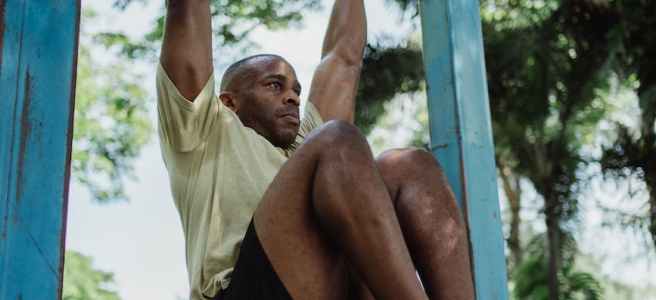
My nemesis was the toe touch. Basically an exercise to test one’s core muscles, it involved hanging on a pull-up bar and then curling your legs at the knees, bringing them to your chest, and then rolling over backwards, such that your toes touch the bar.

It was a difficult one for most of us. Only some chaps, having built enough core strength, had sailed through in the first attempt. While that was some solace, it still meant that there was tremendous work needed to get in shape for the second attempt. A month away.

I was at the lowest level in that exercise then. That meant I could bring my knees folded to my chest, but didn’t have enough core strength to then roll over. Not even an inch.

So, a few of us who were at the same level, formed a squad and got to training. That meant constantly working on our core strength, doing a truck-load of sit-ups and planks, eating in a calibrated fashion, and challenging ourselves on the pull-up bar everyday.

Cutting to the chase, in that one month, we all put ourselves on a regime that extracted a lot from us. Going all in, we didn’t leave even a single bit to chance, steeling our minds to the task. Most of us sailed through in the second attempt. Those who still needed more work, got through in the third one.

But that also taught me one important thing in life.

Most times, it is just you vs. you!!!

We come across multiple challenges in our life. Some of our own choosing, some that just crop up and then some which are thrust upon us. Whatever it may be, most times we must singularly work to overcome it. We may get help from others but unless we have resolved in our mind to ace the challenge, we won’t.

When a new one crops up, we may look at it with skepticism. Will we be able to do it? Will this mean we going beyond our known limits? As long as it is healthy skepticism, it is good. It keeps us in check and grounds us. What we need to be watchful about is that it doesn’t turn into a constant worry and acts as a roadblock.

I believe that’s the key to taking things head on. And succeeding. Knowing what we are up against, and what we need to do to make it count, is half the battle won. The other half is just executing on the plan.

After all, what is life without a new challenge and a plan to overcome it…

What’s with the Age?

We have progressively started living longer lives. But what does it mean to age?

The past week, there were two instances which forced me to think in this direction.

The first one was when my daughter asked a great question, something kids are privileged with. It went something like “why do you need to work on a laptop”?

The second one emerged from a casual conversation with a colleague about how the world has changed for us over the last 25 odd years. And that means most things we do today are done in a different way than when we were born.

As I thought about it, I started looking at my life and how it’s progressed and then to make things more interesting, looked at it from my parents lives.

Imagine someone born in the 50’s in India. Didn’t have radio as a widely used medium, mostly consuming information through newspapers. As she grows up, most interaction is limited to immediate family or neighbourhood.

Then, once she reaches college, she starts to listen to radio and watching more cinema in the theatres. She gets an occasional new thing in her life like a watch or maybe takes a trip to different places to learn.

Years later, well in her 20’s she discovers television, refrigerators, and some bit of computers if she is lucky. But the usage is limited to occasional.

It’s only in her late 30’s that she learns about the Internet. She gets to know how to operate a microwave oven and a washing machine. And a car really becomes a regular vehicle of choice.

With the turn of the century, in her 40’s, life changes as the mobile phone becomes ubiquitous. Internet becomes comprehensible and working on computers becomes the main thing for most office goers. International vacations become widely affordable.

But it’s not until probably in her 50’s that this lady discovers a smartphone. Facebook and video calls. YouTube and WhatsApp. Connected cars and live streaming enter the lexicon in her 60’s.

This lady who is inching towards her 70’s now, has come a long way. And she has had to adapt every step of the way to new things that she couldn’t even imagine as a child. Learning and unlearning, adjusting and accommodating.

For us born in the 80’s or 90’s, most things today seem like a natural progression. But if we think through this lady’s perspective, we realise most of these are way too much to handle.

Yet, our parents handle them on a daily basis. Enjoying the process of getting to know new stuff. Sometimes befuddled, sometimes bemused, but mostly a sport.

And that’s the essence of aging beautifully in today’s material world. Adapting, learning, letting go of things but still holding on to the older self, exploring new things with a keen mindset, and being ready for new experiences.

Perhaps with a new set of questions that we need to ask our kids and grandkids as we make sense of the changes about to come…

Moving Places

We started off as nomads. Adventurous people, living for the moment.

Then, somewhere along the way, we settled down. And became comfortable. With the knowns.

Somewhere, within the economic rhythm of different times, we got the notion that if we settle down and keep working our way through, we will eventually get where we want to.

But what we missed noting is that as our comfort converted into inertia, we got too naive. About other places. About other people. About other cultures. And most importantly about how that newness enriches us.

True, the world has become more globalised. We are travelling far more. People are moving places more than they ever did before.

But are we using that as an opportunity to create that wealth of experience for ourselves? Are we among those people who are ready to have some adventure in life, unsettle a little, experience the wild (not literally always)!

This week, as I started to figure out how to wind up things before a planned relocation, I came across this realization.

Most of us, including myself, in seeking steadiness, have become staid in our lives. We eschew the unknowns, confine to the tried and tested, and smirk at discomfort of any kind.

Even if we face some displacement, there are lot of anxieties that crop up within us. We tend to overanalyse impending changes a lot and weigh too much on pros and cons, to the detriment of our own sanity at times.

It doesn’t need to be so though.

If we just look at life as that adventure that’s waiting to give us a ride, and take ourselves slightly lightly, we will realise that any change is for the good. It always helps uncover things that we didn’t know about ourselves.

And while transitioning through that period of change is cumbersome and not necessary, the process itself yields benefits beyond what we can perceive at the beginning.

Easier said than done, however. Speaking about it from self experience…

Perhaps, the only way out is to believe and roll with it!

Livin’ on the Edge!

This post is in fond remembrance of the roller coaster. Not that amusement parks have gone anywhere but it’s been ages since I visited one, so apt for me to pay my respects.

And not just because I want to go to such a place. Of course, who wouldn’t want to forget all worries and be childlike for those brief moments when you experience bliss (unless you’re freaking out about the possibility of a loose screw somewhere!).

It’s also because thanks to a few planned and unplanned trips, this past month made me remember the good old roller coaster again!

You see, when you travel on roads in India, that’s the feeling you live with all the time. Who said we don’t know how to have a good time. We do it every day of our lives.

As has often been written and mentioned, driving on Indian roads is an art. It’s one that all of us learn pretty much as we grow up and only hone as we get older.

It’s like an enthralling, never ending ride. You keep swerving and swooshing all around. Sometimes out of choice. Sometimes out of compulsion to avoid hitting someone. And sometimes just so that you remain alert while driving!

So, as it happened during my trips, I was mindlessly observing how most people drive. Sitting on the other side of the driver gave me all the time in the world to indulge in this guilty pleasure. And then I observed some more as I drove around town recently.

Well, most of us Indians drive crazily. Period. We don’t know what is a straight line, what is a lane, what are signals for, what is meant by road signs, why there needs to be space between two vehicles, why we need to drive on one side of the road if it doesn’t have a divider in between to separate up and down traffic. The list is endless.

But this is still ok. Our best behaviour is around a signal. When we all are supposed to come to standstill. It’s almost as revealing as attempting a psychometric test. Let me try to explain.

As soon as we near a signal, if it’s a green light, we want to cross over come what may. Even if that means running over someone. Or jumping the signal just as it’s changing colours. We pride ourselves on the ability to beat the timing. After all it’s all about living on the edge…

Even better is when the signal turns red. The vehicles come to a screeching halt. And then everyone starts swerving here and there. As if standing at one place is a crime. The bikes navigate every possible angle to squeeze into any open spaces. It’s like water taking the shape of the maze and filling up all the vacant areas. We don’t leave even an inch. Because of course why waste space! And don’t you forget, the marginal gain is much higher than the few seconds we would lose being two steps behind.

As the signal turns green and we start again, we start to play hide and seek. Swerving and changing lanes at will without any indications, driving as close to each other as possible with absolutely no margin for errors (we are born Schumachers!), honking mindlessly, swearing unconsciously. Mimicking a hungry snake trying to make its way through the ground, wanting to catch its prey at any cost.

Until we reach our destination, we keep up this behaviour. Because no one likes changes, you see. And then as we park and get out, we mention to ourselves “Indian traffic is getting worse by the day”…

For us, it was a hectic but satisfying ride. After all, we beat 3 autos and 5 cars to our destination. To an uninitiated onlooker, it might have been the best example of living on the edge. And how not to drive…

Short-term View

There are people who do the right thing, no matter what. And then there are those who try to do something to take advantage of the situation or get through by any means, even if it means dishonesty.

I often try and behave in the former fashion and naturally like people who also try and do the right thing. I somehow am never able to agree with or like those who try to take undue advantage or are dishonest.

Last week, as we were on a trip, I experienced an incident of the latter type that left a bad taste in my mouth. It was a minor one involving the taxi driver of the cab we hired for our trip. As we ended the trip and had to pay the remaining charges, the driver came up with some false claims and insisted on getting paid for it. While it was a small amount and didn’t affect me much in any which way but what it did end up doing was negating any respect I had for that individual.

As we carried on with our trip, that evening when I sat down with the cool breeze of the lake shore, I reflected on his behavior and what may have caused it. You see, he had behaved immaculately till then but as soon as it was time to depart, he acted with a certain amount of dishonesty and greed. So, it was unexpected for me.

But as I thought deeper, it occurred to me that we often try and take a very short-term view of things. Whether it is something about work or in dealing with others or at home, we often get caught in this quagmire when faced with a choice. Do we think about it from a long-term perspective and are ready to forego certain advantage or benefit in lieu of the relationship or service standard. Or do we think about it from a short-term perspective and try and extract the maximum at that specific moment.

Most service industries or places around us believe in the short-term benefit policy. Why yield when we can get more? Not realizing that in the process the customer leaves with a unsatisfied experience and probably never comes back. On the other hand, those who truly put the customer first provide for a superior experience and have customers for life.

Extending this a little, even in our relationships when we prioritize short-term we gain little in the long run and actually end up fracturing them. But when we focus on the long-term and ensure priorities align accordingly, we continue holding those relationships for life.

In fact, even with any kind of work or activity we undertake. If we keep our focus on the long-term, we get deeper and more involved, benefiting ourselves and enriching our experience. On the contrary, anything attempted with a short-term focus generally is a very superficial one.

Basically, long-term pays more than short-term. We still choose short-term sometimes, neglecting this universal truth. Perhaps because of circumstances, perhaps because of helplessness, or perhaps out of habit.

Whatever it may be, better to think once before deciding on anything with a short-term focus. For while we may gain immediately, we don’t know what all we actually end up losing in the process…

Strong and Weak

Strength is always considered a virtue and weakness a thing to be avoided. But what if we have been thinking all wrong?

1

When I was undergoing training at the Indian Military Academy, we went through the toughest of routines in our initial days. It was a routine that’s usually the case for most armies but not normal for civilians.

So, naturally it took us time to adjust our bearings or even consider it as possible. A lot of us cribbed about it in those initial days. Most of us got used to it in a month or so but a few who couldn’t left.

We thought of ourselves as stronger than them and much more worthy! Naively…

2

All of us tennis fans had a tear in our eye when we watched Federer for the last time and the way it all happened.

However, someone completely clueless about tennis, who saw just a picture of Federer crying in a post match interview after losing (not his last one but some of the earlier ones), may think of him as a sore loser.

Not knowing that here stands a once in a lifetime champion, who’s crying not because he lost but because of the love and support he had received from the crowd and how he felt about it. He was just letting his emotions show.

How wrong would that assumption be about the strength that Federer, or for that matter any other champion, carries within him…

3

Travelling in the Nilgiris mountain ranges yesterday, I was telling my daughter about how people live in these places. How they build their dwellings and carry on with their usual life

I also told her about the big mighty mountains – how they appear so strong and capable of supporting so much. And yet, with so much pressure on them to support the tourism economy, they are also fragile.

My daughter couldn’t grasp initially that the mountains could be weak but as we discussed more and I related it to the environment, she could begin to understand how they could get affected.

An aspect most of us adults know but ignore – that while the environments around us are strong today, if not cared for, could turn weak and wither away!

—

These seemingly unconnected threads ran through my mind over the last couple of days, as I let it wander into free space. But as I looked back, I realised that all of them had one connection.

An assumption about strength and weakness that reflects our usual worldview but isn’t correct. It leads us to behaviours or thoughts which are not the best aligned with the situation or with the people involved.

And yet, knowingly sometimes, we commit this same mistake again and again in different contexts…